
How to Choose RF Cable Assemblies
Selecting the wrong RF cable assembly is a common and costly mistake. The cable you choose directly affects your measurement accuracy, system reliability, and the cost of your test setup. This guide walks through the key specifications to evaluate when selecting RF cable assemblies for test and measurement, defense, or semiconductor applications.
Step 1: Define Your Frequency Range
The frequency range of your application determines the minimum connector size and maximum acceptable cable diameter. For DC to 18 GHz, standard SMA-terminated assemblies with PTFE dielectric are generally adequate. The 18–67 GHz range (K-band through mmWave) requires precision connectors — 2.92mm (K) or 2.4mm — and low-loss dielectric construction. The 67–145 GHz range demands 1.85mm (V) or smaller connectors with ePTFE or air dielectric. Above 145 GHz through 250 GHz, only 1.0mm and 0.5mm connectors maintain adequate cutoff margin. Always specify the cable assembly's maximum operating frequency with margin — a cable rated to 67 GHz should not be used at 65 GHz without reviewing its insertion loss and VSWR specifications at that frequency.

Step 2: Insertion Loss Budget
Every meter of RF cable attenuates your signal — and that attenuation increases with frequency. For a VNA port cable, excessive cable loss reduces the dynamic range available for measurement. For a production test interface, it shifts calibration and increases uncertainty. Insertion loss is specified in dB/meter at defined frequencies; compare this against your maximum acceptable loss for the cable run. Larger-diameter cables have lower loss per unit length but are heavier and less flexible. For most precision test work, the shortest acceptable cable is the best cable. Junkosha's MWX series specifies insertion loss at multiple frequencies across the rated range, enabling accurate loss budget calculations.
Step 3: Phase Stability Requirements
For VNA measurements, phased array systems, and coherent RF applications, phase stability under mechanical flexion and temperature change is critical. Standard coaxial cables can shift 5–20 degrees of phase when repositioned — enough to introduce significant measurement error in precision network analysis. Phase-stable cables, like Junkosha's MWX0, MWX3, and MWX7, use ePTFE tape-wrapped dielectric that isolates the conductor from mechanical strain during bending. When specifying a VNA port cable, look for maximum phase deviation specifications under defined bend conditions. A cable without a published phase stability specification is not a phase-stable cable.
Step 4: Connector Selection
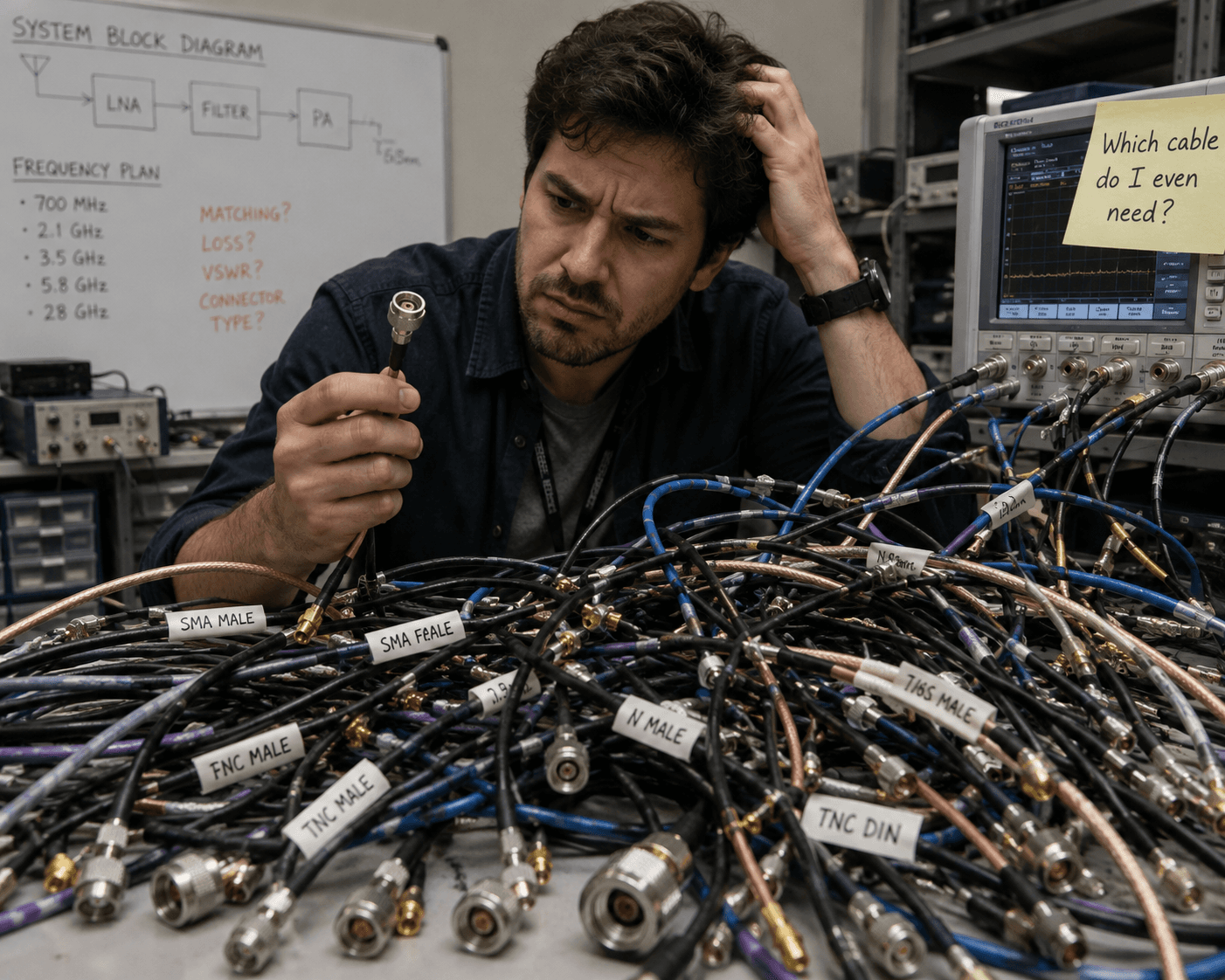
Connector choice is determined by frequency range and mating interface compatibility. SMA (SubMiniature version A) covers DC to 18 GHz and is the most widely used RF connector in test labs. 2.92mm (K-connector) extends to 40 GHz with backward compatibility to SMA. 2.4mm reaches 50 GHz. 1.85mm (V-connector) to 67 GHz. 1.0mm to 110 GHz. 0.5mm (developed in collaboration by Keysight and Junkosha) to 250 GHz. Always match the connector type to your instrument's test port specification — mismatched connector genders or types cause damage and void calibration. For ATE environments with thousands of mating cycles, specify connectors with appropriate cycle ratings.
Step 5: Mechanical Requirements
RF cable assemblies in production ATE environments may flex thousands of times per day. VNA port cables are repositioned repeatedly during calibration and device changeover. Specify minimum bend radius relative to your installation constraints, and confirm the cable's rated flex cycle life for continuous-motion applications. Cable outer diameter affects routing in dense test racks. Temperature range matters for outdoor defense systems and thermal chamber applications. For cleanroom semiconductor test, verify that the cable jacket material meets particle generation and outgassing requirements. Junkosha's MWX series is available in variants optimized for each of these mechanical conditions.
Junkosha MWX Series Overview
Junkosha's MWX series covers the full range of precision RF cable assembly requirements — from general-purpose phase-stable assemblies to the world's broadest-coverage 250 GHz coaxial cable. All MWX series cables are available in Israel through Koto Electronics.
- MWX0 — Precision Test Grade Phase Stability (26.5–145 GHz). Flagship metrology cable for VNA reference measurements and calibration labs.
- MWX1 — Wide Temperature Range, Slim and Durable (up to 67 GHz). Designed for environmental and thermal chamber ATE applications.
- MWX2 — Flexible Cable Assemblies for Measuring Instruments. Low-repulsion flex for tight cable routing in test racks.
- MWX3 — Temperature Phase Stability for Equipment Wiring. Optimized for phase-coherent radar and instrument internal wiring.
- MWX4 / MWX5 — Formable Interconnect. Semi-rigid replacement with field-formable flexibility for fixed routing.
- MWX6 — Precision Skew Matching (up to 120 GHz). Sub-picosecond matched pairs for differential and balanced measurement ports.
- MWX7 — Phase Stability Multi-Purpose (up to 67 GHz). General-purpose phase-stable cable for 5G testing and VNA port use.
- MWX8 — VNA Test Assembly. Purpose-built for vector network analyzer port cables with optimized flex life.
- MWX0A5 — DC to 250 GHz. World's broadest coaxial cable assembly coverage for sub-THz and next-generation research.
- MWX161 — Armored 67 GHz Cable Assembly. Ruggedized construction for field deployment and high-abuse environments.
Need help selecting a product?
Our Israeli technical team is available for consultation, custom specifications, and pricing.
Contact Us