
The Cable Built for Every Move Your Robot Makes.
Standard cables fail on robotic arms and in cable chains. Junkosha's EHF-01 is developed with ETFE fluoropolymer insulation for outstanding bending life — thinner, lighter, and resistant to oil, chemicals, and continuous repetitive motion.
What Happens to a Standard Cable on a Robotic Arm
The Cable That Stops the Line
Your robotic arm completes millions of movements. A standard PVC cable wasn't built for that. It stiffens, cracks, and short-circuits. One day the line stops. Downtime in industrial automation costs thousands per hour — not from a machine failure, but from a cable.
Oil, Chemicals, and Heat That Kill Standard Cables
In a semiconductor production environment or automated assembly line, cables are exposed to coolants, processing chemicals, and high humidity. PVC sheaths swell, crack, and leave conductors exposed. The cost of failure — not just cable replacement but damage to surrounding equipment.
Heavy Cable = Wasted Robot Payload
Every kilogram on a robotic arm is one less kilogram of useful payload — or accelerated wear on the drive joints. Traditional thick multi-core cables add weight that shouldn't be there. You pay for it in power consumption, wear, and reduced precision.
Junkosha EHF-01 — Developed for Repeated Motion
ETFE insulation, three conductor types, three configurations, and optional pneumatic line integration — all in one assembly.
Outstanding Bending Life
EHF-01 is developed specifically for repeated movement — in cable chains and robotic arms. ETFE fluoropolymer insulation delivers far longer bending life than traditional PVC cables, with stable electrical performance across the full cable service life.
Thinner, Lighter, Stronger
Junkosha's technology enables smaller diameter and lower weight compared to traditional cables carrying the same capability. Less weight on the robotic arm — more usable payload, less wear, higher precision.
Resistance to Oil, Chemicals & Outgassing
PVC or polyurethane sheath with ETFE body provides high resistance to coolants, processing chemicals, and industrial oils. Low-outgassing variants available for clean semiconductor production environments.
Three Conductor Types — for Every Requirement
ME1 (tin annealed copper 0.08 mm), ME2 (tin oxygen-free copper 0.05 mm), ME7 (TAT copper alloy 0.05 mm) — each with a unique profile of flexibility, durability, and conductivity. Choose the type suited to your specific application.
Pneumatic & Hydraulic Lines — Same Cable
Junkosha offers integration of hydraulic and pneumatic tubes with electrical signal and power lines within a single composite assembly. Fewer cables on the arm — less tangle, less maintenance, more space.
Choose the Type Suited to Your Application
| Type | Core | Diameter | Key Advantage |
|---|---|---|---|
| ME1 | TA — Tin annealed copper | 0.08 mm | High flexibility, cost-effective |
| ME2 | TO — Tin oxygen-free copper | 0.05 mm | High conductivity, fine diameter |
| ME7 | TAT — Copper alloy | 0.05 mm | Highest mechanical durability |
All types with ETFE insulation. PVC or polyurethane sheath per requirement.
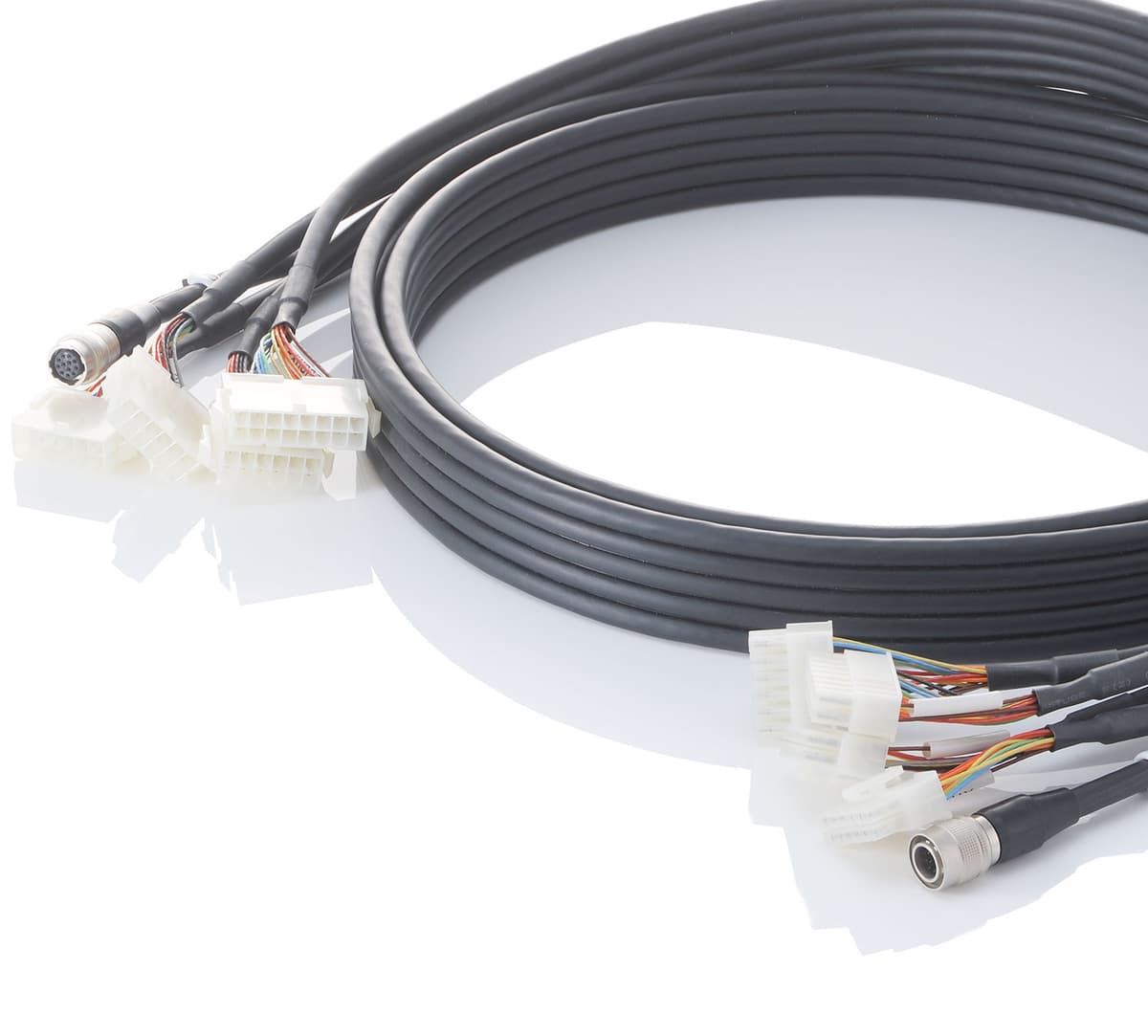
Junkosha EHF-01 — flat and high-flex cable for robotics and cable chain systems
EHF-01 — Technical Data
| Insulation | ETFE Fluoropolymer |
| Sheath | PVC / Polyurethane |
| Conductor Types | ME1 / ME2 / ME7 |
| Wire Diameter (ME1) | 0.08 mm |
| Wire Diameter (ME2/ME7) | 0.05 mm |
| Available Configurations | Flat / Round / Curl |
| Chemical Resistance | Oil, coolants, chemicals |
| Integration | Pneumatic/hydraulic tubes |
For full datasheet — conductor count, outer diameter, maximum current, and available lengths — contact Koto Electronics.
Where the EHF-01 Makes the Difference
Semiconductor Manufacturing Equipment
Cables for robotic arms in lithography, inspection, and wafer processing equipment — resistant to clean-room environments and chemical agents.
Industrial FA Robots
For high-repetition robotic arms on automated assembly lines — extended bending life significantly reduces maintenance stops.
Cable Chain Systems
Repetitive linear motion in cable chains demands cable built for it. EHF-01 withstands cyclic bending and maintains electrical performance over time.
CNC Machinery
CNC environments combine oils, coolants, and continuous motion — exactly what EHF-01's chemical resistance and ETFE construction were built for.
Automated Assembly Lines
Electronics, automotive, and medical device manufacturing — all rely on cables that won't fail at the motion axis.
Automation with Integrated Pneumatic Control
When both electrical signal lines and pneumatic tubes are needed along the same path, EHF-01 can integrate both into one composite assembly.
Frequently Asked Questions
What is the difference between the three conductor types ME1, ME2, ME7?
ME1 uses tin annealed copper (TA) at 0.08 mm diameter — high flexibility and lower cost. ME2 uses tin oxygen-free copper (TO) at 0.05 mm — higher electrical conductivity and fine diameter. ME7 uses TAT copper alloy at 0.05 mm — highest mechanical durability for intensive bending applications.
What is the difference between PVC and polyurethane sheath?
PVC sheath offers lower cost and good resistance for general environments. Polyurethane provides better flexibility at low temperatures, higher resistance to abrasion and coolants, and is better suited to intensive repetitive motion.
Can pneumatic tubes be integrated with signal lines?
Yes. Junkosha offers composite assemblies that include electrical signal and power lines together with hydraulic and pneumatic tubes in a single assembly. This reduces the number of cables on the robotic arm and simplifies cable management.
What cable configurations are available?
EHF-01 is available in three configurations: Flat — ideal for planar movement and height savings; Round — for general use and multi-axis motion; Curl — for motion with gradual extension such as robotic hand wrists.
Is the cable suitable for cleanroom environments?
The ETFE insulation and fluoropolymer sheath provide relatively low outgassing for semiconductor manufacturing environments. For cleanroom environments with strict outgassing requirements, also review EHF-03 (Low Outgassing Cable). Contact Koto Electronics for selection guidance.
Does Junkosha sell directly to Israel?
Koto Electronics is Junkosha's official authorized representative in Israel. Orders, technical support for cable configuration selection, and supply coordination are managed locally in Hebrew.
Stop Replacing Cables. Start Trusting Them.
Koto Electronics — Junkosha's authorized Israeli representative — provides local technical support, conductor type and sheath selection guidance, and direct supply coordination. EHF-01 and high-flex cable questions handled locally, in Hebrew.
Junkosha Inc. — a Daikin Group company. World leader in fluoropolymer cables.