
Inconsistent Liner Stretch Isn't a Process Problem. It's a Liner Problem.
Filmcast and dip-coated PTFE liners elongate unpredictably — causing lamination tears, yield loss, and devices that won't deliver. Junkosha's extruded PTFE liner has higher tensile strength, controlled elongation, and an optimized etch for adhesion even in tapered designs. Available in Israel through Koto Electronics.
Three Ways a Weak Liner Costs You More Than the Liner
Conventional dip-coated and Filmcast PTFE liners are mechanically weak and dimensionally inconsistent. The liner is the cheapest component in the catheter build. The failures it causes are not.
Yield Loss During Lamination
When a PTFE liner elongates inconsistently under tension, it tears, wrinkles, or shifts out of position during reflow. The failure happens inside the catheter jacket — after the outer layers have already been bonded. The liner cost is negligible. The lamination rework or scrap is not.
The Device That Won't Deliver
A liner with low tensile strength can deform radially under the compressive load of a constrained stent or TAVI device, creating friction that prevents deployment. This failure mode typically doesn't appear until clinical testing — after significant development work has been completed.
Tapered Designs That Won't Adhere
Dip-coated and Filmcast liners use a surface coating that becomes unreliable at the transition zones of tapered-ID catheters. If etch depth varies with the application method, adhesion during reflow is inconsistent at the taper — exactly where it matters most.
Extruded. Not Coated. The Difference Is in the Stress-Strain Curve.
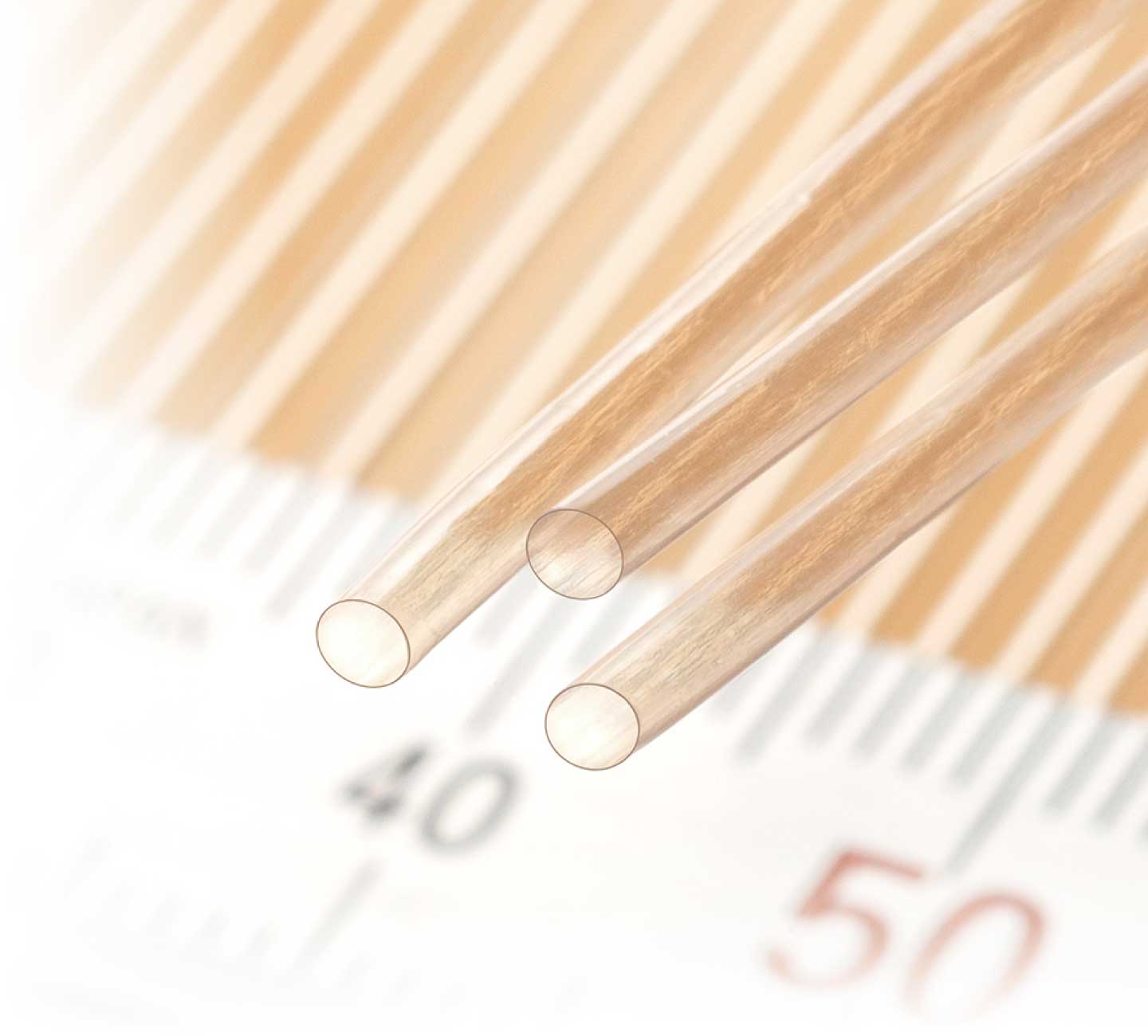
Junkosha extrudes its PTFE liner rather than casting or dip-coating it. Extrusion produces consistent wall thickness, uniform molecular orientation, and predictable mechanical properties — including exactly how the liner behaves under tension during lamination.
- ✓Higher tensile strength — documented by comparison dataAt 400 mm elongation, Junkosha's extruded liner achieves approximately 4.5 N versus approximately 2 N for Filmcast at the same ID. The liner holds under the tension of lamination where conventional liners yield.
- ✓Controlled elongation — less stretch, not moreThe extruded liner elongates less before failure. That is what you want during lamination: a liner that stretches predictably and stays positioned, not one that flows under load and shifts.
- ✓Improved abrasion, scratch, and tear resistanceThe extruded construction resists the mechanical stresses introduced during catheter assembly — pushing devices through the lumen, reflow pressure, and handling. Dip-coated liners are prone to scratching that creates friction sites inside the lumen.
- ✓Optimized etching — including tapered catheter designsThe etch treatment is engineered for Junkosha's extruded PTFE substrate. Adhesion to Pebax, nylon, and polyurethane during reflow is consistent along the liner's full length — including at ID transitions on tapered designs where conventional liners fail.
- ✓Ultra-thin walls from 19 µmAvailable with wall thickness from 19 µm (0.00075") — preserving catheter OD budget where every micron counts. Standard thin-wall options across the full 0.010"–0.200" ID range.
Tensile Strength Comparison
Extruded vs. Filmcast PTFE Liner — same ID (0.019"), stress-strain data
Junkosha's extruded liner reaches ~4.5 N at 400 mm elongation. Filmcast plateaus near 2 N and extends much further before failure — the definition of uncontrolled stretch.
Catheter Applications
- Coil-Reinforced Catheter
Consistent liner ID maintains coil position during lamination
- Delivery Catheter
Especially for self-expandable device delivery — TAVI, stents, coils
- Hypotube-Reinforced Catheter
High tensile strength withstands push/pull forces in the shaft
- Tapered-ID Catheter
Optimized etch maintains adhesion through ID transitions
- Multi-Lumen Catheter
Dimensional consistency across multiple lumens in the same build
Size Capability
Custom combinations of ID, wall thickness, and length available within these ranges via made-to-order samples.
Sample Program
Two paths to qualification. Start with stock. Specify to your exact requirements with made-to-order.
- Shipped from inventory — quick delivery
- 5 pieces per order, limit 2 orders per request
- 21 standard part numbers (0.010"–0.200" ID)
- All 65" (1,650 mm) length
- Custom ID, wall thickness, and length within our range
- Specify elongation and tensile strength requirements
- Shipped in approximately 3 weeks
- Patented Junkosha extrusion technology
Stock Sample Part Numbers
All stock samples: 65" / 1,650 mm length. Subject to availability.
| Part Number | I.D. (in) | Wall (in) | I.D. (mm) | Wall (µm) | Length |
|---|---|---|---|---|---|
| SAMPLE0.010-0.001-65 | 0.010" | 0.001" | 0.25 mm | 25 µm | 65" / 1,650 mm |
| SAMPLE0.020-0.00075-65 | 0.020" | 0.00075" | 0.51 mm | 19 µm | 65" / 1,650 mm |
| SAMPLE0.020-0.001-65 | 0.020" | 0.001" | 0.51 mm | 25 µm | 65" / 1,650 mm |
| SAMPLE0.030-0.001-65 | 0.030" | 0.001" | 0.76 mm | 25 µm | 65" / 1,650 mm |
| SAMPLE0.040-0.001-65 | 0.040" | 0.001" | 1.02 mm | 25 µm | 65" / 1,650 mm |
| SAMPLE0.050-0.001-65 | 0.050" | 0.001" | 1.27 mm | 25 µm | 65" / 1,650 mm |
| SAMPLE0.060-0.001-65 | 0.060" | 0.001" | 1.52 mm | 25 µm | 65" / 1,650 mm |
| SAMPLE0.070-0.001-65 | 0.070" | 0.001" | 1.78 mm | 25 µm | 65" / 1,650 mm |
| SAMPLE0.080-0.0015-65 | 0.080" | 0.0015" | 2.03 mm | 38 µm | 65" / 1,650 mm |
| SAMPLE0.090-0.0015-65 | 0.090" | 0.0015" | 2.29 mm | 38 µm | 65" / 1,650 mm |
| SAMPLE0.100-0.0015-65 | 0.100" | 0.0015" | 2.54 mm | 38 µm | 65" / 1,650 mm |
| SAMPLE0.110-0.0015-65 | 0.110" | 0.0015" | 2.79 mm | 38 µm | 65" / 1,650 mm |
| SAMPLE0.120-0.0015-65 | 0.120" | 0.0015" | 3.05 mm | 38 µm | 65" / 1,650 mm |
| SAMPLE0.130-0.0015-65 | 0.130" | 0.0015" | 3.30 mm | 38 µm | 65" / 1,650 mm |
| SAMPLE0.140-0.0015-65 | 0.140" | 0.0015" | 3.56 mm | 38 µm | 65" / 1,650 mm |
| SAMPLE0.150-0.0015-65 | 0.150" | 0.0015" | 3.81 mm | 38 µm | 65" / 1,650 mm |
| SAMPLE0.160-0.0015-65 | 0.160" | 0.0015" | 4.06 mm | 38 µm | 65" / 1,650 mm |
| SAMPLE0.170-0.0015-65 | 0.170" | 0.0015" | 4.32 mm | 38 µm | 65" / 1,650 mm |
| SAMPLE0.180-0.0015-65 | 0.180" | 0.0015" | 4.57 mm | 38 µm | 65" / 1,650 mm |
| SAMPLE0.190-0.0015-65 | 0.190" | 0.0015" | 4.83 mm | 38 µm | 65" / 1,650 mm |
| SAMPLE0.200-0.0015-65 | 0.200" | 0.0015" | 5.08 mm | 38 µm | 65" / 1,650 mm |
* Subject to availability. In case of stock shortage, alternative arrangements may apply.
Frequently Asked Questions
What's the actual difference between extruded and Filmcast PTFE liner?
Why does less elongation improve lamination yield?
What does 'optimized etching' mean for tapered catheters?
How does liner tensile strength relate to device deliverability?
What wall thicknesses are available?
Can I specify elongation and tensile strength targets for made-to-order samples?
Free Stock Samples. Your Spec. Three Weeks.
Stock samples ship from inventory — free, five pieces, no commitment. Made-to-order samples hit your exact ID, wall thickness, and mechanical property targets in approximately three weeks. The qualification starts with a sample request.