
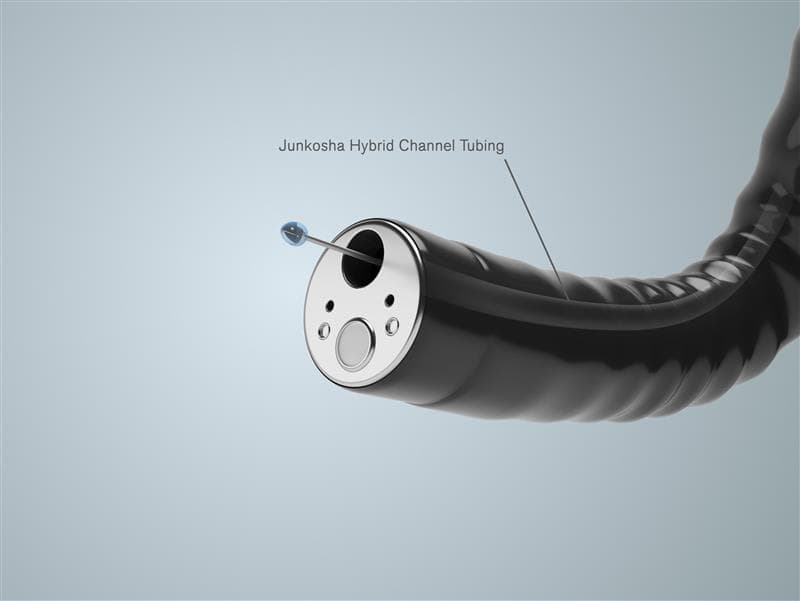
Hybrid Channel Tubing for Endoscopic Applications
Channel tubing is the backbone of the working channel in flexible endoscopes — it must guide instruments, withstand repeated deflection cycles, and maintain dimensional stability under suction and irrigation pressures. Junkosha's Hybrid Channel Tubing addresses all three demands through a co-extruded architecture: a smooth PTFE inner layer paired with an expanded PTFE (ePTFE) outer layer.\n\nThe PTFE inner surface delivers the low-friction instrument passage that endoscope manufacturers require for reliable tool deployment and withdrawal. The ePTFE outer layer contributes compliance and kink resistance, maintaining the channel's cross-section through tight bending radii at the endoscope's distal tip. The two-layer construction also distributes stress more evenly across the wall thickness during repeated flex cycles — a key factor in endoscope service life.\n\nPressure performance is maintained across the operating range despite the thin wall construction. The tubing passes standard hydrostatic and leak tests representative of clinical operating conditions.\n\nFor endoscope OEMs, the hybrid design simplifies material qualification by combining properties that previously required separate components or adhesive bonding. The tubing is compatible with standard endoscope assembly processes including heat bonding and laser welding.\n\nKoto Electronics supplies Junkosha's full medical cable and tubing range in Israel, including the EAF endoscope cable series and this new Hybrid Channel Tubing. Contact us for samples, technical specifications, and delivery lead times.