
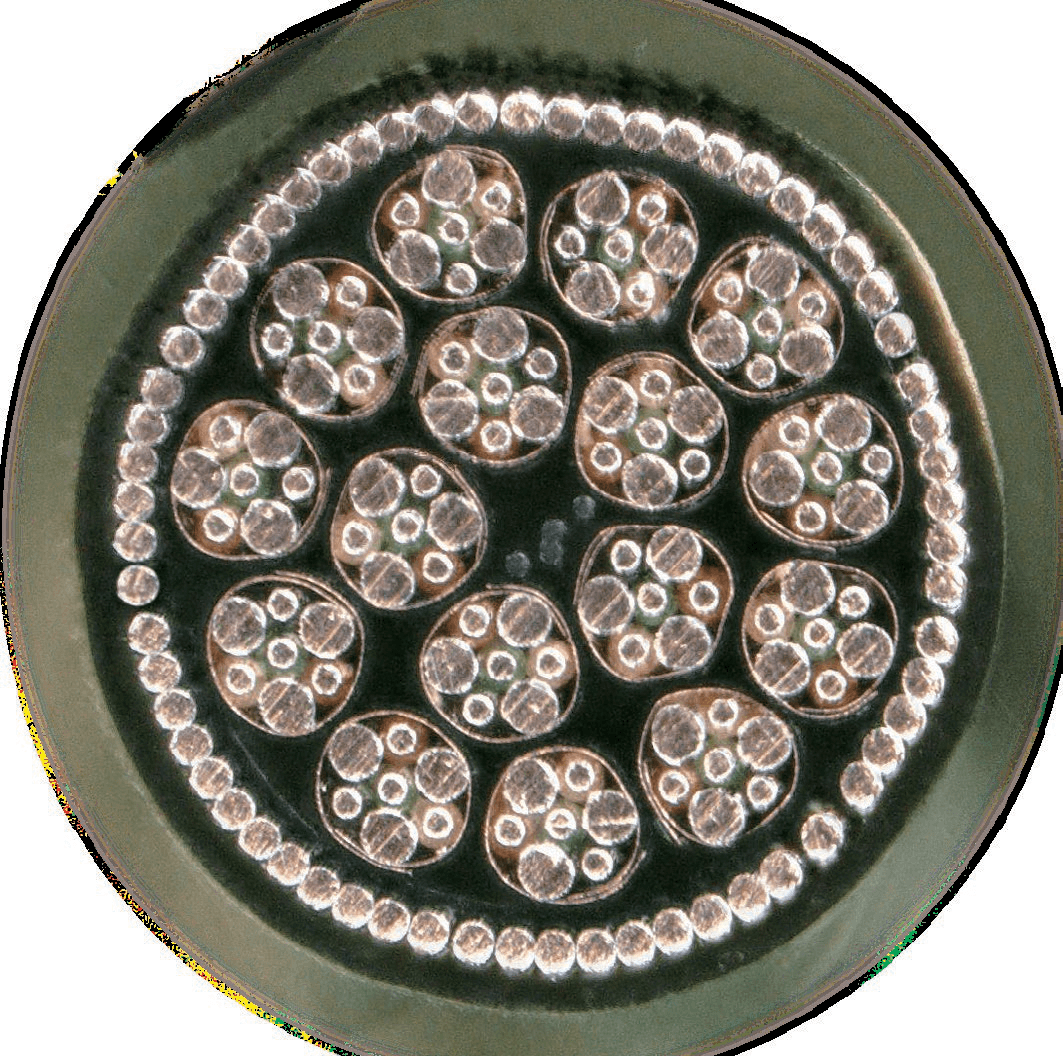
What Is an MCT Cable? 64 Ultrasound Channels in a 1 mm Cable
Junkosha's patented Multi-Channel Transmission (MCT) cable replaces bundles of coaxial cables and FPC subassemblies in intracorporeal ultrasound probes — cutting outer diameter by up to 43% while keeping coax-grade signal quality.
The Problem: Ultrasound Is Moving Inside the Body
Highly specialized ultrasonic probes deployed inside the body cavity now diagnose organs and blood vessels that surface probes cannot reach — intracardiac echo catheters navigating the heart, intravascular ultrasound threading through arteries, and ultrasound endoscopes imaging from within the GI tract.
To navigate the body's expansive and complex vasculature, delivery devices and probe units must keep shrinking. But an ultrasound transducer still needs a signal line per element — commonly 64 channels — and the cable bundle carrying them quickly becomes the bottleneck that decides how small the catheter can be.
The MCT Concept: One Engineered Structure Instead of a Bundle
A Multi-Channel Transmission (MCT) cable is Junkosha's patented answer: instead of bundling dozens of individually shielded coaxial cables — each carrying its own jacket and dead space — the MCT integrates all signal channels into a single engineered multi-core structure. The cross-section below shows the result: 64 channels inside a 1 mm outer diameter.
Thinner
The MCT structure is thinner than the outer diameter of an equivalent coaxial bundle, so signal-line count can grow within the same — or a smaller — footprint.
Coax-Grade Signal Quality
Signal quality is equivalent to a coaxial cable, so MCT drops into existing designs — and advanced coupling technology can improve overall system signal quality.
Flexible
The MCT bends more freely than traditional constructs, improving the movement of catheter and endoscope delivery systems inside the body.
Process Friendly
A simplified, centralized cable structure reduces device-assembly man-hours and improves yields and quality — lowering total manufacturing overhead.
MCT vs. Coax: The Numbers
For a 64-channel transmission line, the outer-diameter comparison between an MCT cable and an equivalent coaxial bundle looks like this:
64-Channel Outer Diameter Comparison
| Conductor Size | MCT | Coax | Reduction |
|---|---|---|---|
| AWG #44 | 1.57 mm | 2.77 mm | −43% |
| AWG #46 | 1.50 mm | 2.19 mm | −32% |
| AWG #48 | 1.12 mm | 1.68 mm | −33% |
| AWG #50 | 1.00 mm | 1.53 mm | −35% |
Capacitance: 115 pF nominal · Characteristic impedance: 50 Ω nominal
Case Study: a 1.25 mm Catheter Lumen, 64-Channel Probe
With a 1.25 mm cable lumen, an AWG#50 coax bundle measures 1.22 mm — an almost zero-clearance fit. The AWG#50 MCT measures 0.98 mm, restoring real clearance. And stepping up to AWG#48 MCT (1.16 mm) still fits with room to spare while significantly improving transmission characteristics — better insertion loss across the ultrasound band, sharper image quality, and an easier catheter assembly process.
The Integrated Structure: Termination Without Relay Boards
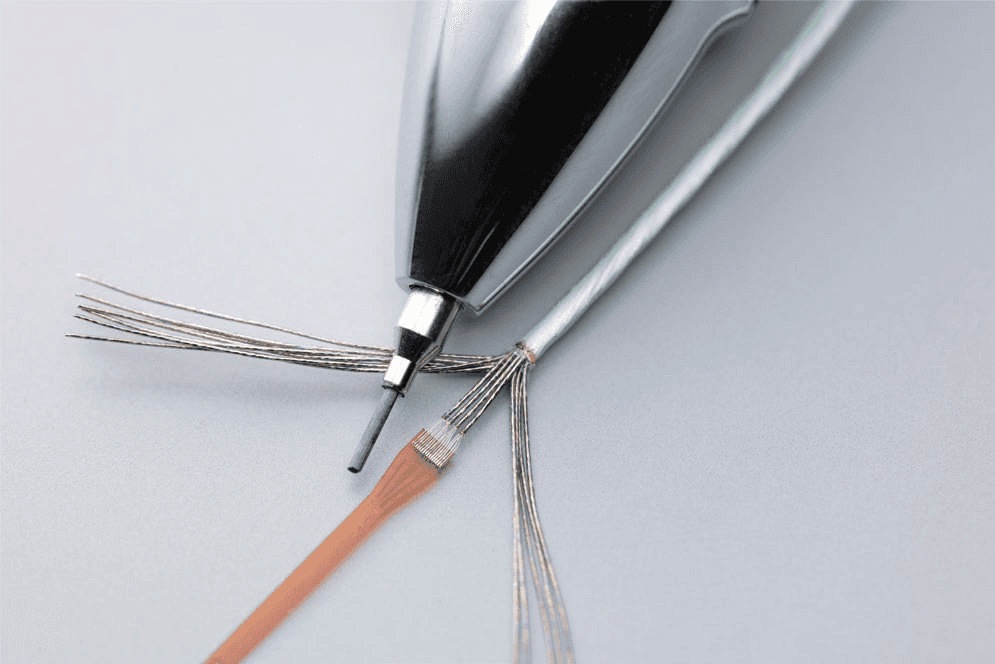
Getting 64 hair-thin conductors soldered to a transducer is its own manufacturing challenge. Junkosha's patent-pending "integrated" structure pre-processes the cable ends: stripped conductors are pre-soldered onto a molded polyimide insulation film with matching through-holes. The customer simply aligns the film with the connection board and thermal-presses — the solder melts through the through-holes and completes all joints in one operation.
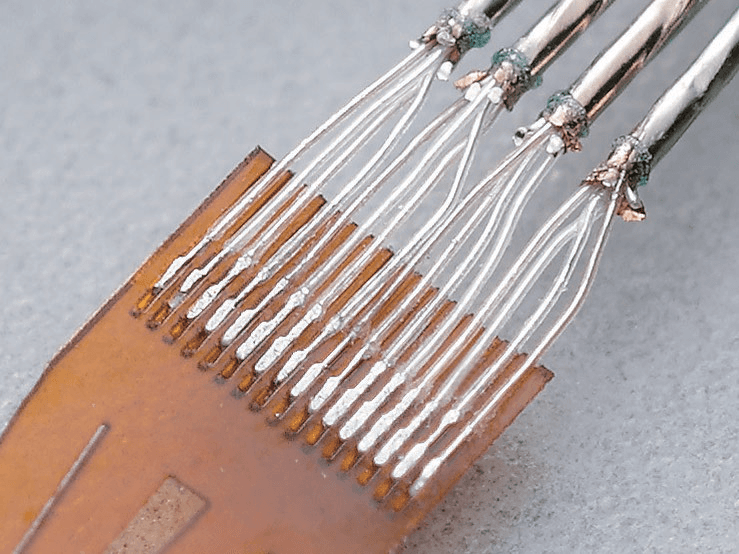
What the Integrated Structure Eliminates
- Relay boards and additional FPCs in the device design — reducing cost and shortening pad dimensions for further miniaturization
- High-touch soldering that requires special tooling or jigs
- Third-party supply of critical interconnect components
- Connection-quality variance — the process can be automated, stabilizing joint quality in the finished device
Where MCT Cables Are Used
Intracardiac Echocardiogram (ICE)
Catheter-mounted ultrasound imaging from inside the heart chambers, guiding structural heart procedures and electrophysiology.
Intravascular Ultrasound (IVUS)
Imaging from inside coronary and peripheral arteries, where every hundredth of a millimeter of catheter diameter matters.
Transesophageal Echo (TEE)
High-resolution cardiac imaging through the esophagus, demanding many channels through a flexible endoscope shaft.
Ultrasound Endoscopy
Endoscopic ultrasound of the GI tract and adjacent organs, combining optics and ultrasound in one slim insertion tube.
The Product: EAF-03 MCT Cable and Assembly
The MCT technology is available as the Junkosha EAF-03 Multi-Channel Transmission Cable and Assembly, in conductor sizes AWG#44 through AWG#50, as cable or as a complete subassembly with integrated termination. Full specifications, the insertion-loss comparison chart, and the assembly process are in the official catalog.
Designing an Intracorporeal Ultrasound Device?
Koto Electronics is the exclusive authorized distributor of Junkosha in Israel. Contact our technical team for MCT specifications, conductor size selection, integrated subassembly options, and samples for ICE, IVUS, TEE, and endoscopic ultrasound programs.