

Probe Cables for Ultrasound Diagnostic Equipment: 30 Years from AWG#32 to AWG#50
How Junkosha engineered ultrasound probe cables that weave more than 100 ultra-fine coaxial cables into a single flexible assembly — and shrank the conductor from 0.24 mm to 0.025 mm, the thickness of a human hair.
Imaging the Body Without Radiation
Ultrasound diagnostic equipment lets healthcare professionals examine the inside of the body safely — during pregnancy scans, cardiac echo studies, and routine health check-ups — without pain and without radiation exposure. The probe the clinician holds against the patient contains an array of transducer elements, and every element needs its own signal path back to the imaging system.
That signal path is the probe cable — and it is anything but ordinary. Junkosha has supplied cables for medical ultrasound equipment for more than 30 years, and this case study from Junkosha's innovation archive shows what it took to get there.
The Engineering Challenge
The client brief called for strong, thin, flexible cables that would deliver clear images. Each of those requirements pulls against the others:
Constant Motion
During diagnosis, clinicians repeatedly rotate and slide the sensor across the patient's body. The cable flexes with every movement, thousands of times a day.
High-Density Signals
Visualizing the inside of the body requires very high signal density — over 100 individual coaxial channels running through one slim cable.
Zero-Failure Reliability
An accurate diagnosis can affect patient survival. The cable must keep performing even if an individual strand is stressed — reliability is a clinical requirement, not a spec line.
Numerous Prototypes, Built on Fluoropolymer Expertise
Junkosha's answer drew on its advanced knowledge of fluoropolymer technology, applied as the cable dielectric. The team pursued a low-capacitance cable design through relentless experimentation: minimizing dielectric thickness, creating pore structures within the insulation (the expanded-PTFE approach that later defined Junkosha's ultra-fine cables), and stabilizing the shield technology around each conductor.
Flexibility came from a specialized twisting method: weaving at least 100 ultra-fine coaxial cables together so the finished assembly bends freely, while the woven construction preserves strength — the failure of any individual strand does not compromise diagnostic accuracy.
Four Prototypes in Days
Despite the complexity, Junkosha's cross-functional team structure enabled a rapid response to the client brief — four prototype samples were produced in just a few days, with a company-wide functional team providing integrated expertise from production planning through execution.
30 Years of Refinement: AWG#32 to AWG#50
The first ultrasound probe cable Junkosha delivered used AWG#32 conductors with a diameter of 0.24 mm. Three decades of continuous refinement later, the company mass-produces AWG#50 cable with a conductor diameter of just 0.025 mm — roughly the thickness of a single human hair, and nearly a 10× reduction.
Conductor Evolution
| Generation | Conductor Diameter | Comparison |
|---|---|---|
| AWG#32 (first generation) | 0.24 mm | Fine sewing thread |
| AWG#50 (current, mass-produced) | 0.025 mm | A single human hair |
Image-accuracy demands from equipment makers increase every year, driving continuous advancement. Junkosha's view is simple: high-precision cables directly impact the patient's quality of life and the confidence of the medical staff reading the image.
The Product Today: EAF-06 Ultrasound Echo Probe Cable
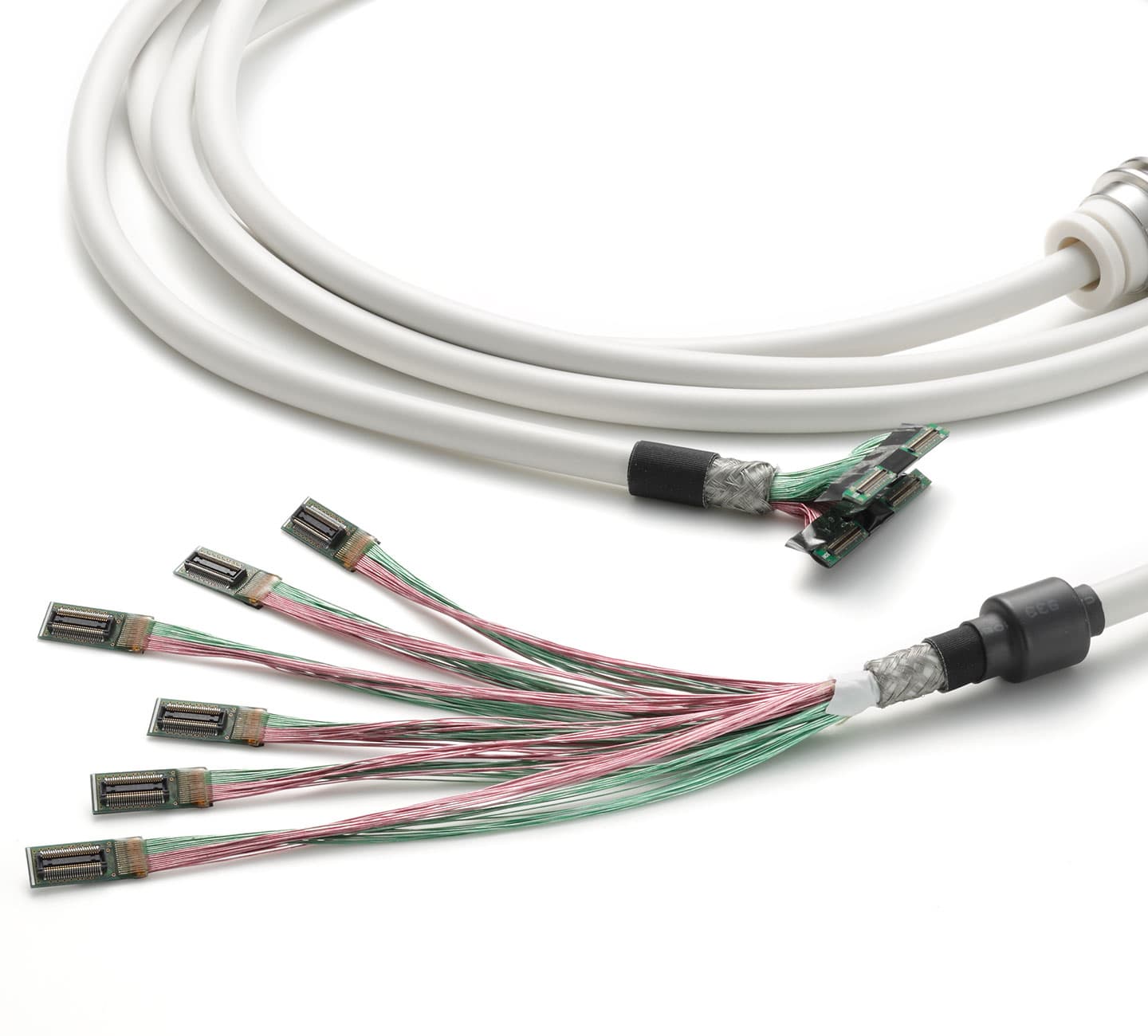
The technology developed in this case study lives on in the EAF-06 Cable and Assembly for Ultrasound Echo Probes — combining a very high conductor count, compact outer diameter, ultra-low crosstalk, and the flexibility clinicians need for all-day probe handling.
- Up to hundreds of conductors in one compact cable
- Ultra-low crosstalk between channels
- Durable jacket engineered for clinical use
Beyond Ultrasound: The Same DNA in Every Ultra-Fine Cable
The low-capacitance dielectric design, pore-structure insulation, and multi-strand weaving techniques proven in ultrasound probes now underpin Junkosha's entire ultra-fine cable family — from AWG50 twisted pairs for endoscopes and catheter imaging to ultra-fine flat cables for miniaturized analytical devices. When a cable must carry many channels through a tiny, constantly moving space, this is the technology stack that makes it possible.
Building a Medical Device That Needs Ultra-Fine Cables?
Koto Electronics is the exclusive authorized distributor of Junkosha in Israel. Contact our technical team for EAF-06 specifications, custom conductor counts, assembly options, and samples for ultrasound, endoscopy, and catheter-based imaging systems.