
Introduction: Why RF Cable Selection Changes in Vacuum
When an RF cable assembly is placed inside a vacuum chamber, it enters an environment that is fundamentally different from anything it was likely designed for when its RF and mechanical specifications were established. Vacuum changes the behavior of materials, the dissipation of heat, the risk of contamination, and the long-term reliability of connector interfaces. A cable that performs perfectly in ambient air can create real problems inside a vacuum system.
This guide covers the key factors that must be considered when selecting RF cables for vacuum applications: outgassing and contamination control, material selection, connector design, bake-out compatibility, RF discharge risk, radiation effects, magnetic compatibility, and documentation requirements.
What Is Outgassing and Why Does It Matter?
Outgassing refers to the release of gases trapped or dissolved in solid materials when those materials are exposed to vacuum. Every solid material outgasses to some degree. Metals, ceramics, and most fluoropolymers outgas at rates low enough that they are acceptable even in demanding vacuum systems. However, standard cable jacket materials — including many grades of PVC, polyethylene, polyurethane, rubber, and foam — can release significant amounts of gas in vacuum. Labels, adhesives, inks, heat shrink materials, potting compounds, and boot adhesives are also potential sources of outgassing.
In high and ultra-high vacuum systems, outgassing from cable materials can degrade vacuum quality, increase pump-down time, and potentially contaminate nearby optical surfaces, wafers, mirror coatings, sensor windows, detector elements, or precision instrument surfaces. For space simulation and TVAC testing, outgassing materials can deposit residue on the spacecraft hardware being tested, which may affect measurements or cause real contamination of optical and sensitive surfaces.
ASTM E595 and Other Outgassing Test Methods
The ASTM E595 test method measures the outgassing of solid materials in vacuum using three parameters: Total Mass Loss (TML), Collected Volatile Condensable Material (CVCM), and Water Vapor Regained (WVR). A material that passes ASTM E595 screening — typically TML no more than 1.0 percent and CVCM no more than 0.10 percent — is considered acceptable for many space and vacuum applications as a starting point.
However, ASTM E595 data for a dielectric or jacket material does not automatically qualify the complete cable assembly. Heat shrink tubing, adhesives, labels, ink marking, boots, and assembly process residues must all be evaluated. For strict vacuum or space applications, a full assembly outgassing evaluation may be required.
Fluoropolymers in Vacuum RF Cables
Fluoropolymer materials — including PTFE, FEP, PFA, and ETFE — are widely used in vacuum-compatible RF cable assemblies because of their combination of low outgassing, chemical inertness, temperature stability, and, in the case of PTFE, excellent RF dielectric properties. PTFE in particular has a very low dielectric constant and very low dielectric loss, making it the most common choice for precision microwave cable dielectrics. FEP and PFA are often preferred for jackets because they can be extruded over cable constructions more easily than PTFE while still providing low outgassing and chemical resistance.
ETFE (ethylene tetrafluoroethylene) offers better mechanical toughness than PTFE or FEP and better radiation resistance. This makes it useful for environments that combine vacuum with radiation exposure, such as particle accelerators and some space systems. PEEK (polyether ether ketone) is not a fluoropolymer but is used in vacuum-compatible connector insulators and mechanical components because of its strength, temperature resistance, and vacuum compatibility.
Connector Design for Vacuum Applications
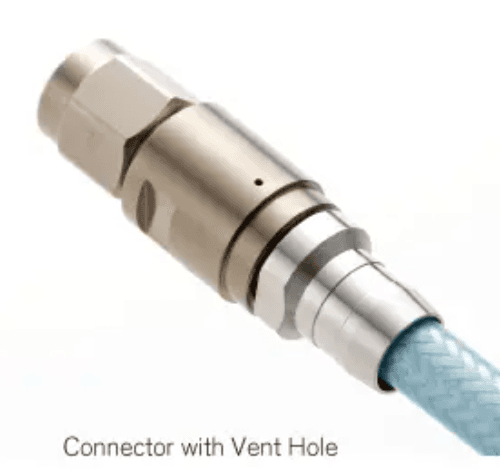
In vacuum systems, the connector is often the most important component to review after the cable dielectric. Standard RF connectors were not designed specifically for vacuum use. Several issues can arise:
Trapped volumes inside connector bodies can slow pump-down and require careful venting. Connector insulators made from materials with higher outgassing rates can contaminate the chamber. Non-magnetic requirements may not be met by standard connectors. Bake-out requirements may exceed the rated temperature of standard connector bodies or insulators.
Vented RF connectors address the trapped-volume problem by providing a design pathway for gas to escape. Hermetic feedthroughs are used when an RF signal must enter or exit a vacuum chamber through the chamber wall: a hermetic coaxial feedthrough maintains the vacuum boundary while passing the RF signal at the required frequency and power level.
Bake-Out Compatibility
Most high-vacuum and ultra-high vacuum systems require bake-out — a controlled heating of the vacuum chamber and all internal components to elevated temperature — to drive off surface-adsorbed gases and achieve low base pressure. Cable assemblies installed inside the chamber must be able to withstand the bake-out cycle without damage, without significant additional outgassing at the bake-out temperature, and without degradation of RF performance after cooling back to operating temperature.
Typical bake-out conditions range from approximately 80 degrees C to 150 degrees C for periods of 24 to 48 hours, depending on the vacuum system type, the cleanliness requirements, and the materials involved. The weakest material in any cable assembly sets the maximum allowable bake-out temperature for the assembly as a whole. A cable assembly where the cable body is rated to 200 degrees C but the heat shrink or boot adhesive is only rated to 80 degrees C may fail or outgas heavily if baked above 80 degrees C.
RF Discharge and Multipaction in Vacuum
At higher RF power levels in vacuum, a phenomenon called multipaction (sometimes spelled multipactor) can occur. Multipaction is an RF discharge caused by resonant electron multiplication between closely spaced conductive surfaces in a vacuum. As the RF field accelerates electrons across a gap, secondary electrons are emitted from the conductor surfaces, and if the geometry and frequency are in the right range, these secondary electrons can be re-accelerated in phase with the RF field, leading to an exponential increase in electron current that can cause signal distortion, heating, and even arc damage.
Multipaction is especially relevant in satellite payloads, high-power radar systems, and high-power microwave feedthroughs for plasma or accelerator applications. For TVAC testing of satellite hardware, the RF power levels used in testing can bring multipaction into play. The risk depends on frequency, gap dimensions, conductor material, and surface condition — factors that are usually analyzed by RF simulation for critical designs. Cable assemblies used in high-power vacuum RF applications should be reviewed for multipaction risk as part of the system design.
Radiation Effects on Cable Materials
In particle accelerators, space environments, nuclear research facilities, and radiological measurement applications, the cable materials must also be evaluated for radiation resistance. Ionizing radiation — including gamma, X-ray, neutron, and charged-particle radiation — can degrade polymer materials over time. PTFE is particularly susceptible to radiation-induced embrittlement. Under sufficient accumulated radiation dose, PTFE can lose mechanical flexibility, crack, and fail. This makes PTFE a poor choice for cables that will be located in high-radiation zones in accelerators or nuclear research environments, even if its RF and vacuum properties are otherwise excellent.
ETFE has significantly better radiation resistance than PTFE and is often preferred for cables in radiation environments. PEEK also has better radiation resistance than PTFE. Polyimide can be suitable for very high-temperature or very high-radiation environments.
Magnetic Compatibility
In particle physics detectors, MRI-adjacent test systems, magnetometer calibration facilities, and some quantum computing experimental setups, the magnetic properties of cable and connector materials can affect measurements. Standard RF connectors often contain stainless steel components, spring contacts, or ferromagnetic plating materials that can disturb sensitive magnetic field environments. Non-magnetic connector variants, typically using beryllium-copper or brass body materials with non-magnetic plating, may be required for these applications.
When magnetic compatibility is a requirement, the entire cable assembly — including the cable braid material, the inner conductor material, any shield termination clips, and all connector components — should be reviewed for magnetic permeability.
Junkosha RF Cable Assemblies for Vacuum Applications
Junkosha manufactures precision RF and microwave cable assemblies using PTFE-based and fluoropolymer dielectric constructions that are suitable starting points for vacuum applications. The EMF series phase-stable cable assemblies use expanded PTFE (ePTFE) tape-wrapped dielectric constructions, which provide excellent RF phase stability under temperature cycling — a critical requirement for TVAC testing where the cable assembly must maintain consistent RF transmission characteristics as the temperature cycles between hot and cold conditions.
For specific TVAC, space simulation, UHV, or particle accelerator applications, the cable assembly materials, cleaning procedures, heat shrink selection, connector choice, and documentation requirements should be discussed with Koto Electronics technical support to ensure the selected assembly meets the full system requirements.
Summary
RF cables for vacuum applications require a significantly more detailed review than RF cables selected only for frequency, power, and connector type. The key parameters to evaluate include: cable dielectric and jacket material outgassing, ASTM E595 or equivalent data for critical applications, connector design for vacuum including vented or hermetic types, bake-out compatibility of the full assembly, RF performance stability under temperature cycling, RF discharge and multipaction review for high-power applications, radiation resistance for particle accelerator and space environments, magnetic compatibility for magnetically sensitive systems, cleanliness and handling requirements, and material documentation appropriate for the application.